

The morning after the presidential town hall debate, we posted a question to our Facebook friends: “What would you have asked the candidates if you had been in the audience at last night’s debate?” We got hundreds of replies on a range of topics. From now until Election Day (Nov. 6), we’ll do our best to answer your questions for the candidates by researching what they’ve said on the issues in the past.
Karin O. Shepherd-Buchanan would ask the candidates:
“Will you work toward getting rid of Citizens United?”
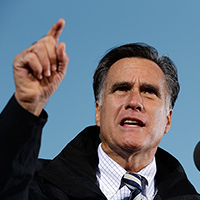 In past statements, Mitt Romney has said he supports Citizens United but dislikes the super PACs it created. He favors overturning campaign finance laws, such as the McCain-Feingold Act, so that donors can give as much money to a campaign as they would like. Romney says this system would require immediate public disclosure of the donations.
Romney also agrees with the part of the Supreme Court’s ruling that says corporate spending is speech, protected by the first amendment. At the 2011 Iowa State Fair, while being heckled by protestors, Mitt Romney suggested that to fulfill promises regarding entitlement programs, the administration would have to “raise taxes on people.”
“Corporations!” a protester yelled, suggesting that taxes be raised on corporations.
“Corporations are people, my friend,” Romney replied, summarizing the implications of the Citizens United decision.
“No, they’re not!” someone else yelled.
“Of course they are,” Romney replied. “Everything corporations earn ultimately goes to people. Where do you think it goes?”
In an interview with NBC’s Chuck Todd in December 2011, Mitt Romney clarified his position. “I think the Supreme Court’s decision was following their interpretation of the campaign finance laws that were written by Congress,” he said. “My own view is now we tried a lot of efforts to try and restrict what can be given to campaigns, we’d be a lot wiser to say you can give what you’d like to a campaign.”
In the same interview, he later said: “I’m not going to criticize the Supreme Court, I’m going to criticize Congress for passing a law that limits what campaigns can receive and opens the door to these super PACs and to PACs which have now been around for a while.”
Last month, Romney drew criticism from both sides when he contradicted his previous stance and said huge campaign donations to Democrats from teachers’ unions present a conflict of interest. “I believe that we simply can’t have a setting where the teachers unions are able to contribute tens of millions of dollars to the campaigns of politicians, and then those politicians, when elected, stand across from them at the bargaining table, supposedly to represent the interest of the kids,” Romney told Brian Williams.
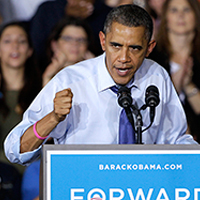 In past statements, Barack Obama has voiced opposition to Citizens United.
On July 16, the day the DISCLOSE Act failed in the Senate, the Obama campaign released a statement in support of the Act. Describing the court’s decision on Citizens United, the president wrote, “The consequences of this decision are predictable. If we allow this practice to continue, special interests will have unprecedented influence over politicians. It’s wrong. It’s corrosive to our democracy, and it’s a threat to our future.”
On August 29, in an “Ask Me Anything” chat on Reddit, the president responded to a question about money in politics by affirming his commitment to overturning Citizens United. He wrote, “Over the longer term, I think we need to seriously consider mobilizing a constitutional amendment process to overturn Citizens United (assuming the Supreme Court doesn’t revisit it). Even if the amendment process falls short, it can shine a spotlight of the super-PAC phenomenon and help apply pressure for change.”
The president’s team had previously stated that Obama was in favor of an amendment to overturn Citizens United, but this position was muddied by the president’s endorsement last winter of the super PAC supporting his candidacy, Priorities USA Action.
