
What Matters Today

Ten Things You Should Know About #TheRealTANF

We’re proud to collaborate with The Nation in sharing insightful journalism related to income inequality in America. The following is an excerpt from Nation contributor Greg Kaufmann’s “This Week in Poverty” column.
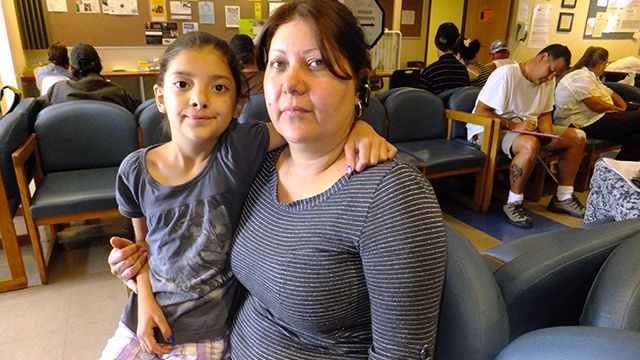

Claudia Pedroza, Karla Osorio
Claudia Pedroza moved to the Denver suburbs five years ago with her husband and four children in hopes of a more comfortable suburban life, but her family still struggles to make ends meet. In this photo, Pedroza and her eight-year-old daughter Karla Osorio wait on line at the Jefferson Action Center in Lakewood, Colo., to apply for help with food and toiletries and to seek a new frying pan. (AP Photo/Kristen Wyatt)

The Temporary Assistance to Needy Families (TANF) program was created by what is commonly referred to as “welfare reform” in 1996. It replaced Aid to Families with Dependent Children (AFDC) as the program through which some low-income families are able to receive cash assistance.

With TANF authorization expiring at the end of March and needing to be renewed (and hopefully improved) — and over 46 million people still living below the poverty line of $23,021 for a family of four — here are ten things you should know about the program:

1) There is no cash entitlement program for people living in poverty in the U.S. States (including Washington, D.C.), the tribes and the territories have wide discretion, so there are more than fifty different TANF systems in the country.

2) Most people in poverty do not receive cash assistance. In 1996, for every 100 families with children in poverty, there were 68 families who accessed cash assistance. In 2011, for every 100 families with children in poverty, 27 accessed cash assistance.

3) Over the last 16 years, the number of people receiving TANF cash assistance has declined by 60 percent, even as poverty and deep poverty — people living below half the poverty line — have increased.

4) TANF is reaching fewer children. In 1995, AFDC kept over 2.2 million poor children — over 62 percent of all poor children — out of deep poverty.  In 2005, TANF lifted just 21 percent of children who would otherwise be in deep poverty, or just 650,000 kids.

5) The cash benefit is less than 50 percent of the poverty line in every state— so less than $9,000 for a family of three — and less than 30 percent of the poverty line in most states, or less than $5,500 annually for a family of three.

6) The TANF block grant has been frozen since 1996 so its value in real terms has declined by over 30 percent. Congress also recently failed to fund the Supplemental Grants for 17 poorer states which had received them since 1996, reducing the overall funding of these high poverty states by as much as 10 percent.

7) The “work participation rate” is a failed measure that stifles effective career pathways. The federal government rewards or penalizes states based on whether TANF recipients are doing “countable activities,” with no assessment as to whether those activities lead to employment entry, job retention, advancement or poverty reduction. So sweeping a county garage might be an approved activity, while post-secondary education leading to a wage that supports a family may not be permitted at all, or only for a limited number of recipients.

8) The work participation rate discourages states from serving the most “needy” families that have multiple barriers to employment — such as physical or mental health limitations, a child with a health problem or an experience with domestic violence — even though these are the people with the most to gain from employment assistance. The priority is serving people who are able to meet the work requirements with little or no assistance.

9) The TANF Emergency Fund placed more than 260,000 low-income adults and youth in paid jobs at the height of the recession. Thirty-seven states participated in this public-private partnership, and it earned bipartisan support from governors. But Congress allowed it to expire in September 2010.

10) A weak TANF has contributed to a rise in deep poverty. The number of people living in deep poverty has risen from 12.6 million in 2000 to 20.4 million people today. This includes over 15 million women and children — 9.8 percent of all children.

#TheRealTANF


Greg Kaufmann is a Nation contributor covering poverty in America. His work has also appeared on Common Dreams, Alternet, Tikkun.org, NPR.org, CBSNews.com and MichaelMoore.com. He serves as an adviser for the Economic Hardship Reporting Project.

BillMoyers.com encourages conversation and debate around issues, events and ideas related to content on Moyers & Company and the BillMoyers.com website.

  • The editorial staff reserves the right to take down comments it deems inappropriate.
  • Profanity, personal attacks, hate speech, off-topic posts, advertisements and spam will not be tolerated.
  • Do not intentionally make false or misleading statements, impersonate someone else, break the law, or condone or encourage unlawful activity.

If your comments consistently or intentionally make this community a less civil and enjoyable place to be, you and your comments will be excluded from it.

We need your help with this. If you feel a post is not in line with the comment policy, please flag it so that we can take a look. Comments and questions about our policy are welcome. Please send an email to feedback@billmoyers.com

Find out more about BillMoyers.com's privacy policy and terms of service.

  • idlelies

    I wish this list of facts would have discussed the time limitations on TANF. Many people are erroneously under the impression that families can earn this benefit indefinitely.

  • Basil99645

    This is a disgrace to this country. No wonder we rank so low in the world in so many areas. We know better. That we just don’t give a damn about each other is so sadly proven by these statistics. We’re better than this. Aren’t we? Or has greed become so common place that no one gives it a second thought? We make up lies to tell ourselves so that we can live with this attitude and reprehensible treatment of our fellow man.
    We will wake up or continue to suffer the consequences. I say no more babies die!
    Thank you for your voice. Thank you for your research and thank you for having the courage to tell the truth.

  • http://twitter.com/LCinLA Linda Coburn

    I appreciate programs like TANF. But I disagree with the final paragraph of this piece. It is not a weak welfare program that has contributed to a rise in deep poverty. It is the lack of decent paying jobs, affordable education and housing, and the deep divide between the haves and have nots that has been the primary contributor to a rise in deep poverty. It is the greed of corporate America, where CEOs make 100s of times more pay than their average employee and the corruption of our government that feeds on this greed that is the cause of deep poverty in this great, abundant country of ours. Nobody should NEED this kind of program in such a wealthy nation, and certainly not hundreds of thousands of people.

  • Anonymous

    Since the benefits of the program have been so uneven and eroded and the requirements for participation demanding and possibly self defeating (depending on the state that’s administering it), the participation rate is only 27 of 100 families in deep poverty. I would not be surprised if this is completely discontinued at the end of March, citing low participation and budget cuts.

    Since Clinton “deformed” welfare, it has become increasingly crippled and disabled. This country gives lip service to caring for children, but realities can tell a different story.

    The push to demonize medicaid is also shameful. My child would have been dead several times over and crippled were it not for medicaid. She is 22, in college, healthy and thriving. Early interventions do help individuals and society to benefit. Can’t we just please cut the war-making?

  • http://www.facebook.com/aaron.archambault.9 Aaron Archambault

    I am all for helping the truly needy, but a government programs will never be the answer. There is a problem in the country and around the globe, and it is lack of community and too much dependence on “everyone else”, or the government. If a person “makes it” and builds up a business, they should not be under any obligation to give that money to anyone, unless they choose to. I know it is harsh, however i believe that if you did not have the government stealing from everyone, then people would be much more generous. The government who just makes money out of thin air so people think they are free to just give it to everyone. I got news, that money is digging us into a big pit and greater economies have collapsed under similar situations. I think reform is needed to bring the help back to where it can actually help people and then there will be less waste and fraud, and our government can downsize and continue to exist, or we stay on the current path and end up like the great Ottoman empire, or the Roman empire, and our children and grand children will read about how great USA was, as it will no longer exist.