Although public support of capital punishment has been falling since its peak in 1994 — when 80 percent of Americans said they favored it — approval numbers have plateaued in the 60th percentile over the past decade.
Gallup first started polling about the death penalty in 1936. At that time, 59 percent of Americans were in favor of it. Although support dropped in the 1960s — including the all-time low of 42 percent in 1966 — it rose steadily in the 1970s and ’80s. MORE
Supreme Court Justice Anthony Kennedy told reporters that he is concerned that many politically charged issues are coming before the high court. (AP Photo/Rich Pedroncelli)
Starting today, the Supreme Court is hearing two monumental cases relating to same-sex marriage, both at a time when public opinion polls show a growing number of Americans support marriage equality.
A Pew Research Center poll released last week found that 49 percent of Americans support gay marriage and took a deeper look at the reasons why.
The Pew data is most applicable to the case before the Supreme Court determining whether California’s Proposition 8, banning gay marriage in the state, is constitutional. The other case deals with the 1996 Defense of Marriage Act (DOMA), which officially defines marriage as between a man and a woman and denies federal benefits to same-sex partners of government employees. A Gallup poll released on Friday found that, if it were put to a vote, 54 percent of Americans would cast a ballot to allow same-sex partners of federal employees to receive benefits, while only 37 percent would vote to not allow it. MORE
Marie Arrasate, left, and Joan McGarr discuss their Social Security payments during an AP interview in 2009 at the Southwest Focal Point Senior Center in Pembroke Pines, Fla. (AP Photo/J Pat Carter)
A new report by the Washington Post shows that the growing economic inequality in the United States affects the life expectancy of Americans in different income brackets. According to research at the University of Washington, women living in affluent St. Johns County, Fla., can expect to live to be 83 years old, four years longer than they did two decades ago. Male life expectancy has also improved — it’s more than 78 years, six years longer than 20 years ago.
But just next door, in less wealthy Putnam County, women can only expect to live to be 78, and men, 71 — representing an increase of only a year and a year and a half, respectively, over the same time period. In St. Johns County, life expectancies have increased by roughly four times more than in Putnam County over two decades.
The widening gap in life expectancy between these two adjacent Florida counties reflects perhaps the starkest outcome of the nation’s growing economic inequality: Even as the nation’s life expectancy has marched steadily upward, reaching 78.5 years in 2009, a growing body of research shows that those gains are going mostly to those at the upper end of the income ladder.
Dried sunflowers are seen in a field near the Bulgarian capital Sofia in August 2012. After the harshest winter in decades, the Balkans were facing the hottest summer and the worst drought in nearly 40 years. The record-setting average temperatures -- steadily rising over the past years as the result of the global warming -- have ravaged crops, vegetable, fruit and power production in the region which is already badly hit by the global economic crisis. (AP Photo/Valentina Petrova)
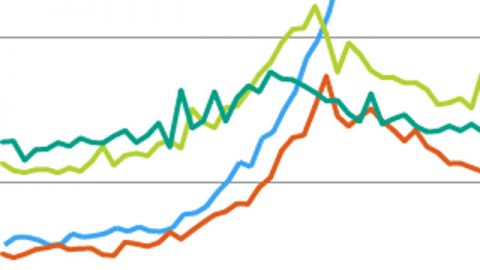
A new study published in the journal Science provides context for just how dramatic our planet’s recent warming trend is. In the last century, during which humans have been burning fossil fuels on a widespread scale, the planet’s temperatures have changed more dramatically than they had during all of recorded human history — more dramatically than they had since the last ice age ended.
“We already knew that on a global scale, Earth is warmer today than it was over much of the past 2,000 years,” said Shaun Marcott of Oregon State University, the paper’s lead author. “Now we know that it is warmer than most of the past 11,300 years.”
The planet’s gradual warming and cooling phases are largely caused by the Earth’s tilt as it orbits around the sun. During the period the OSU and Harvard University research team reconstructed, temperatures increased gradually until about 7,000 years ago, then began decreasing again. If not for human influence, Earth would be in a very cold period today. But soon after the industrial revolution happened, the planet began to warm.
Chart from the Wall Street Journal, data from Oregon State University and Harvard University
Since 2009, income growth among the majority of Americans has remained relatively stagnant. But an updated version of economist Emmanuel Saez’s study, “Striking it Richer,” shows that this is not true for the top one percent of Americans.
The study found that since the recovery began in 2009, while the bottom 99 percent of Americans’ incomes have fallen by 0.4 percent since the recovery began in 2009, the top one percent’s incomes have risen by 11.2 percent. So the recovery is only truly a recovery for the wealthiest Americans.
Since the 1970s, the wealthiest one percent increasingly have earned a larger and larger share of America’s income. The recession in the early 2000s and the “Great Recession” starting in 2007 decreased their earnings, but — as the chart below shows — the top one percent still earned more than the next four percent of income earners combined. And since the recovery began in 2009, the top one percent’s incomes have bounced back more than that of any other percentile. MORE
Kassandra Guzman, an 18-year-old high school student from Queens, N.Y., works seven days a week and said she still has trouble saving for college after helping her parents pay their bills. (AP Photo/Mike Groll)
Today, a single parent earning minimum wage takes home $15,080 a year. That’s $3,400 below the federal poverty line for a family of three. President Obama noted the statistic in his State of the Union Address — “That’s wrong,” he said, calling for an increase in the minimum wage to $9 an hour because “in the wealthiest nation on Earth, no one who works full-time should have to live in poverty.”
The minimum wage has not always left a single income-earner for a family of three so far below the poverty line. In 1968, when minimum wage was at it’s highest point ever, that same breadwinner would have made $19,245 a year in today’s dollars — roughly a third more than he or she makes now.
In 1981, in an attempt to fight inflation, the minimum wage was frozen at $3.35 per hour despite the rising cost of living. It wasn’t bumped up until 1990, by which point it had fallen well below the poverty line for a family of two (about $2,500 lower than for a family of three). From 1997 to 2007, the minimum wage remained stuck at $5.15 per hour, as, once again, the cost of living continued to increase.
Between 2007 and 2010, the federal minimum crept up to $7.25 per hour, though individual states were given the power to raise the minimum wage above the national one, and nineteen have taken that opportunity. Now, Obama says, it’s time for the minimum wage to increase again nationally. MORE
According to a report from the National Telecommunications and Information Administration (NTIA), a certain amount of America’s lack of high-speed Internet can be attributed to population density. America is far more spread out than, say, Korea, and faster connections are possible when the length of the wires from the phone company to your home is shorter. But that’s not the full story — in Canada, a country far less dense than the U.S., 72.2 percent of households have broadband.
The National Broadband Map is a tool to search, analyze and map broadband availability across the United States. The colored portions of the map indicates Internet speed rates of at least 768 kbps.
Across America, access to high-speed Internet varies tremendously — even within a single community — an issue several federal communications commissioners have committed themselves to addressing. MORE
Mexican immigrant Roberto Garcia, center, and son Alan, left, look at wrist watches while shopping in Los Angeles, Monday, Jan. 28, 2013. (AP Photo/Jae C. Hong)
If you’re worried about the economy, you should also be worried about the fate of immigration reform. According to this 2010 analysis by The Brookings Institution’s Hamilton Project, the idea that immigrants are a drag on the economy — a belief shared by many Americans – is simply incorrect.
Immigrants coming to America are split between those who are highly educated and those who arrive without a high school diploma. On one end of the spectrum, immigrants are nearly twice as likely as U.S.-born citizens to have a PhD; at the other end, immigrants are four times more likely than U.S. citizens to have not graduated from high school.
Yesterday, eight senators — four Democrats, four Republicans — released a memo outlining legislation for immigration reform. A separate bipartisan group in the House is working on its own plan that representatives hope to roll out before Obama’s State of the Union two weeks from now. Meanwhile, President Obama gave a speech in Las Vegas today explaining the need for immigration reform, and offering his own proposal.
Optimists might say that 2013 could be the year when Congress acts on immigration. This “immigration roadmap” from Immigration Road, a San Diego organization that seeks to make the process more transparent, demonstrates one reason why reform is needed. As currently structured, the road to naturalization is an elaborate and tricky maze which those seeking to stay in America permanently must work their way through for years. MORE
The vast gap between rich and poor in Latin America has long been notorious. In fact, it grew even more during the 80s and 90s. But over the last decade, income inequality in Latin America has been rapidly decreasing, while inequality in the U.S. has skyrocketed in the other direction, as the top 1 percent of earners pulls further and further away from the middle class and poor.
Over the last half a century, income inequality in the U.S. has grown more than in any other western country. As a result, the U.S. is now one of the more unequal countries in the Americas, according to the U.N. Economic Commission for Latin America and the Caribbean’s Statistical Yearbook, released earlier this month. Incidentally, the most equal country on the list, Uruguay, is led by a president who lives on his wife’s farm and gives 90 percent of his salary to charity, leaving himself with an income of $775 a month — in line with the average Uruguayan. MORE