Donors Trust: The ATM for Climate Denial

According to Mother Jones and The Guardian newspaper, over the past decade, a little-known group called Donors Trust has funneled hundreds of millions of dollars from wealthy contributors to a host of right-wing organizations, advocacy groups and think tanks. MJ‘s Andy Kroll dubs it the “dark-money ATM of the right” because of all the conservative campaigns the group had bankrolled. He writes:

Founded in 1999, Donors Trust (and an affiliated group, Donors Capital Fund) has raised north of $500 million and doled out $400 million to more than 1,000 conservative and libertarian groups, according to Whitney Ball, the group’s CEO. Donors Trust allows wealthy contributors who want to donate millions to the most important causes on the right to do so anonymously, essentially scrubbing the identity of those underwriting conservative and libertarian organizations.

MORE

Karl Rove’s New Plan to Take Over the Senate in 2014

Karl Rove, former senior advisor and deputy chief of staff to former President George W. Bush, right, talks to Sen. Orrin Hatch, R-Utah, on the floor of the Republican National Convention in Tampa, Fla., on Monday, Aug. 27, 2012. (AP Photo/David Goldman)
(AP Photo/David Goldman)

Karl Rove and his American Crossroads super PAC are back with a new plan to achieve a Republican majority in the Senate in 2014. The New York Times reports that American Crossroads is creating the “American Victory Project,” an outside spending group whose purpose is to support moderate Republicans who are threatened in primary races by far-right challengers.

American Crossroads spent about $104 million on the last election with little success. Nearly all of the candidates the group supported lost. The Sunlight Foundation calculated that only 1.29 percent of Crossroads’ spending lead to the result they were looking for. MORE

Who Really Won the Election? Campaign Consultants

Ryan Gosling played a fictional political consultant in 2011's political thriller The Ides of March.

Ryan Gosling played a fictional political consultant who becomes disillusioned with the process in 2011's political thriller The Ides of March. Credit: Saeed Adyani/Columbia Pictures

Candidates come and candidates go but campaign consultants live on, no matter the outcome of the election, continuing to cash in even as they look for their next victims. And with the post-Citizens United explosion of money now available via super PACs and 501c4s (the “social welfare” groups that keep their deep-pocketed donors anonymous), the potential, ongoing profits are more enormous than ever.

For example, Bloomberg News recently reported, “More than five months after Newt Gingrich dropped out of the Republican presidential primary, the founder of the super-political action committee backing him was still drawing a check. In fact, almost half of the $480,000 Rebecca Burkett paid herself as founder of Winning Our Future came after the former House speaker quit the race.”

… While the 2012 election is over, the financial windfall for political consultants and fundraisers spawned by the millions of dollars donated to super-PACs continues — and often with little oversight.

Entrepreneurs who set up super-PACs wrote their own paychecks. The new groups sometimes moved as much money into the pockets of employees as they did into races. And some showed evidence of self-dealing.

According to the Center for Media and Democracy’s PR Watch, “In 2012, the total spending of outside groups — the super PACs and dark money nonprofits which spend money to influence elections, but do so separately from campaigns — amounted to about $1.3 billion.” As a result, a handful of consultants are making out like bandits.

MORE

How Michigan’s Right-To-Work Law Came to Be

Right To Work Michigan
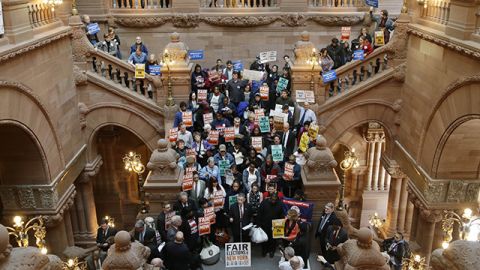
Protesters gather for a rally at the State Capitol in Lansing, Mich., Tuesday, Dec. 11, 2012. (AP Photo/Paul Sancya)

As police held back thousands of protesters near the state capital building, Michigan, the birthplace of the modern labor movement, became the 24th state to enact so-called “right-to-work” legislation. Earlier today, Governor Rick Snyder signed two bills preventing public and private sector unions from requiring workers to pay union fees.

The Detroit News reports that after requests from Grover Norquist and others, Snyder switched sides on the issue. United Auto Workers President Robert King said in an interview, that the Koch brothers and Amway owner Dick DeVos “bullied and bought their way to get this legislation in Michigan.”

In an editorial headlined “Drinking the Kochs’ Kool Aid,” the Detroit Free Press was unable to account for the governor’s change of heart, but offered some theories on the motivations of State Senate Majority Leader Randy Richardville. He may have been under pressure, the newspaper said, from the anti-union Americans for Prosperity and the American Legislative Exchange Council (ALEC), both financially supported by the Koch brothers. ALEC’s model right-to-work bill “mirrors the Michigan law word for word.” MORE

Moyers Moment (2009): Karen Armstrong on the Power of Compassion

In this Moyers Moment from a 2009 episode of Bill Moyers Journal, Bill talks with Karen Armstrong about her discovery of compassion within herself, and her work to understand world religions and global politics through the lens of compassion.

KAREN ARMSTRONG: I learned a vicious form of rhetoric from my religious superiors. And also from my teachers at Oxford. You know? And people used to say to me, "I would really hate to be your enemy," because I have this very sharp tongue that I knew how to use it. And I get in first before someone put me down. That kind of thing.

I found that, in my studies I had to practice, what I found called in a footnote the "science of compassion." There was a phrase coined by great Islamist, Louis Massignon. Science, not in the sense of physics or chemistry but in the sense of knowledge, scientia, the Latin word for knowledge.

And Latin — the knowledge acquired by compassion. Feeling with the other. Putting yourself in the position of the other. And this footnote said that a religious historian, like myself, must not approach the spiritualities of the past from the vantage point of post enlightenment rationalism. You mustn't look on this in a superior way and look at the author of The Cloud of Unknowing, a 14th century text as, "poor soul." You know?

And you had to recreate in a scholarly fashion, all the circumstances which had resulted in this spirituality or this teaching and not leave it, or certainly not write about it, until you can imagine yourself — putting yourself in that position. Imagine yourself feeling the same. So when I wrote about Muhammad, for example, I had to put myself in the position of a man living in the hell of seventh century Arabia, who sincerely believed he had been touched by God.

And unless I did that, I would miss Muhammad. I had to put clever Karen, edgy Oxford educated Karen, on the back burner. And go out of myself and enter into the mind of the other. And I found, much to my astonishment, it started changing me. I couldn't any longer be quite as vicious as I was or dismissive as I was in the kind of clever conversations —

BILL MOYERS: Why? This is the first time I've heard of a born again experience beginning with a footnote. Was it your imagination that said, "I have to see this world the way Muhammad saw it and experienced it?"

KAREN ARMSTRONG: I said that this footnote is right. If I go on writing, as I had been doing up to this point for saying, "This is all rubbish." You know, I know it all. These poor benighted souls in the past didn't know what they were talking about. I was not fulfilling my job as a historian.

It was my job to go in and recreate it, enter into that spirit. Leave myself behind and enter into the mind and society and outlook of the other. It's a form of what the Greeks called ekstasis. Ecstasy. That doesn't mean you go into a trance or have a vision. It means — ekstasis means standing outside yourself. Putting yourself behind. And it is self, it's ego that hold us back from what we call God.

BILL MOYERS: You speak of the change in you. You're talking about a personal transformation. But take the next step. What would bring about the kind of real change in society and in politics that would be an extrapolation of or a continuation in community of what you're talking about?

KAREN ARMSTRONG: Okay. Not to treat other nations or other — in a way that we would not wish to be treated ourselves.

BILL MOYERS: Unless they've attacked you.

KAREN ARMSTRONG: Even so, I mean, there was a chance after 9/11, you know, when something different would have been done. The religions have generally developed, as the Koran does, a theory of just war. You know? That you can fight only in self-defense. But a lot of the policies that we created helped to, you know, first of all, let's leave America out of this. Look at the British, and their colonial policies.

Many of the problems we face in the Muslim world date back to that colonial period, to British behavior, and arrogance, and the abuse of democracy. For example, in Egypt, between 1922, when Egypt was granted a modicum of independence, and 1952, when you have the Nasser revolution. There were 17 general elections in the country, all of them won hands down by the Wafd party, who wanted to see reduced British influence in Egypt. They were only allowed to rule five times. On every other occasion, the British made them stand down and put more congenial people in power. This made the whole idea of democracy a bad joke. Now, would we wish to be treated like that ourselves?

BILL MOYERS: Now, this is what some people call blow back, in the intelligence world. And some people say, "Are the chickens coming home to roost?" But I want to make sure that people don't misunderstand. After 9/11, we made a mistake of invading a country that had not attacked us.

KAREN ARMSTRONG: Yes.

BILL MOYERS: But what about when the Japanese bombed Pearl Harbor or when the Germans, the Nazis wanted to come across the channel and destroy Britain? You're not saying they're to treat Germany or Japan the way we would like to be treated.

KAREN ARMSTRONG: No, but you fight in self-defense. And the trouble with war is it has a horrible dynamic of its own. So that, in the end, we all start doing dreadful things that...

BILL MOYERS: That's right.

KAREN ARMSTRONG: ...that violate all our own principles. Like the British bombing of Dresden, for example.

BILL MOYERS: The American bombing of Hiroshima.

KAREN ARMSTRONG: Exactly.

BILL MOYERS: Nagasaki. The atrocities of both sides —

KAREN ARMSTRONG: That's what happens when in war. So that's why they say you — the Koran, for example, says you must limit war and you must stop hostilities as soon as the enemy sues for peace. That kind of thing. But instead of seeing the other world as them, or instead of seeing our own fundamentalists as them and enemies, somehow learn to see, perhaps, the pain that lies at the root of a lot of this because they feel attacked by us.

MORE

Moyers Moment (2007): Benjamin Barber on Holiday Capitalism

Are Black Friday, Cyber Monday and other hallmarks of holiday consumerism examples of genuine supply and demand, or is capitalism manufacturing an unnecessary need in order to to feed itself? In this November 2007 Moyers Moment from Bill Moyers Journal, political theorist Benjamin Barber, author of Jihad vs. McWorld, says we’re buying things “we don’t want or need or even understand.”

“Capitalism needs us to buy things way beyond the scope of our needs and wants [in order to] to stay in business. That’s the bottom line,” Barber tells Bill. “Capitalism is no longer manufacturing goods to meet real needs and human wants. It’s manufacturing needs to sell us all the goods it’s got to produce.”

BILL MOYERS: Here we are, at the height of the holiday season. The malls and the shops are packed. Stuff is flying off the shelves. And like Grinch or Scrooge you stand up and say, "Capitalism's in trouble." Why?

BENJAMIN BARBER: Because things are flying off the shelves that we don't want or need or even understand what they are, but we go on buying them. Because capitalism needs us to buy things way beyond the scope of our needs and wants to stay in business, Bill. That's the bottom line. Capitalism is no longer manufacturing goods to meet real needs and human wants. It's manufacturing needs to sell us all the goods it's got to produce.

BILL MOYERS: But on the Friday after Thanksgiving, you know, go to the mall. Black Friday, the mall in Burlington, Vermont, where I happened to be, was just packed with people. I mean, they're not in there buying nothing. You're saying that they don't need that stuff?

BENJAMIN BARBER: Sure don't. And they don't need to shop at 4:00 AM. I mean, I've been looking for signs saying, "Please open the stores at 4:00 AM so I can go shopping at 4:00 AM." I don't see any. I mean, that's the stores' ideas. That's the marketers' ideas. That's the idea to create this hysteria about purchasing. About buying and selling. That makes Americans feel that if they're not in the store at 4:00 AM or 2:00 AM, and some of them open at midnight Thursday. And now a whole bunch were open on Thanksgiving.

BILL MOYERS: But, Ben, nobody is forcing them to do that. People are out there looking for bargains. You like a good bargain don't you?

BENJAMIN BARBER: I love a good bargain when it's for something I need and something I want. But here's the thing--here's the thing. We live in a world where there are real needs and real wants. And there's no reason why capitalism shouldn't be addressing those real needs and those real wants.

BILL MOYERS: Well, give me an example.

BENJAMIN BARBER: Give you a fine example. Here in the United States, we do -- the Cola companies, which couldn't sell enough Cola, figure out, why sell Cola when we can sell water from the tap that people can get for free, but we'll sell it in bottles from the tap. Twenty billion a year. Twenty billion dollars a year in bottled water.

BILL MOYERS: Right. Right. In bottled water.

BENJAMIN BARBER: In the third world there are literally billions without potable, without drinkable, without clean water. Now why shouldn't capitalism figure out how to clean the water out there and get people something they need and make a buck off it, because that's what capitalism does. It makes a profit off taking some chances and meeting real human needs. Instead of convincing Americans and Europeans that they shouldn't drink pure clean tap water but instead pay two bucks a bottle for it.

BILL MOYERS: Those people out there don't have the money to buy it. So that-- why would a company go into a place where people don't have money and try to sell them something?

BENJAMIN BARBER: In capitalism you don't expect a profit right away. You make an investment. You create jobs. You create products, you create productivity. That's the way it works. That's the way we created, in the west, our prosperity. But we don't have the patience any longer to do it in the third world. We don't want to bring them into the marketplace. We'd rather exploit a finished marketplace. But you're right, here's the paradox, those with the dough don't have any needs. Those with the needs don't have any dough. And so--

BILL MOYERS: Right.

BENJAMIN BARBER: --capitalism has to decide how to treat it. And their decision has been to go for the dough, regardless of the needs. I was called on Black Friday by a lot of radio and TV stations.

BILL MOYERS: Black Friday, the day after Thanksgiving.

BENJAMIN BARBER: "Tell us what's going on? What's wrong with American consumers?" Which is kind of what you and I have been talking about. But the trouble is we're looking the wrong way. It's not what's wrong with American consumers, it's what's wrong with American capitalism, American advertisers, American marketers? We're not asking for it. It's what I call push capitalism. It's supply side. They've got to sell all this stuff, and they have to figure out how to get us to want it. So they take adults and they infantilize them. They dumb them down. They get us to want things.

Watch Bill’s full conversation with Benjamin Barber.

Survey Says: “Money Undermines Democracy”

A copy of a campaign finance report from the super PAC "Vermonters First." (AP Photo/Toby Talbot)

During this election, we saw Democratic politicians oppose super PACs and other political nonprofits — but still accept help from them — while Republican politicians largely embraced the new groups, many created by the 2010 Supreme Court decision in Citizens United v. FEC.

But voters aren’t so polarized on the issue. A report released yesterday by the Public Campaign Action Fund, a nonprofit focused on campaign finance reform, says Americans across the political spectrum are in favor of scaling back the amount of money going into campaigns. Another indication of the same sentiment can be found in Colorado and Montana, where ballot initiatives supporting a constitutional amendment to overturn Citizens United were approved by an overwhelming percentage of the electorate — 74 percent in Colorado, 75 percent in Montana.

“This is the one area where Democrats and Republicans — people who voted for Obama or Romney, people who voted for Democrats or Republicans — are very close together in their views,” said Democratic strategist Stan Greenberg, whose polling organization worked with the Public Campaign Action Fund to survey voters. “People believe in limits [on spending]. It’s almost a universal position in the country — that there should be limits.”

See charts after the jump.

MORE

Debt Prevention on Capitol Hill

The fiscal cliff negotiations aren’t the only debt consolidation talks going on in our nation’s capitol this week. The campaign may be over but the committees to re-elect are still fundraising — not for 2014 or 2016 — but to cover their 2012 debts.

Two days after Election Day, Roll Call reporter Janie Lorber noted that lawmakers “[e]ager to retire campaign debt and prepare for the next election cycle… will split their time between debt talks and dozens of fundraisers.”

The events cost anywhere from $500 to $2,000 a head, although some lobbyists who made contributions in the final weeks of a campaign attend events — held at the Capitol Hill Club and the Capital Grille among other swanky spots — at no charge. …

Most new members of Congress will come to town with at least some debt from their campaigns, and early fundraisers present a prime opportunity for lobbyists get to know the newest faces on Capitol Hill.

MORE

This Week in Dark Money: Nov. 9, 2012

We’re proud to collaborate with Mother Jones in sharing insightful journalism related to money and politics. We’ll be posting this weekly roundup every Friday. Share your thoughts about these must-read stories and always feel free to suggest your own in the comments section.

A quick look at the week that was in the world of political dark money

QUOTE OF THE WEEK

“The billionaire donors I hear are livid. There is some holy hell to pay.”

— A Republican operative speaking to the Huffington Post about Karl Rove, who “has a lot of explaining to do.” Rove’s super PAC American Crossroads and dark-money group Crossroads GPS spent at least $175 million, but just nine of the 30 candidates that Crossroads supported won. Rove, who claimed that Obama won reelection “by supressing the vote” and with the help of Hurricane Sandy, reportedly held a phone briefing with top donors on Thursday to explain Crossroads’ lack of success.

MORE

Majority of Super PAC Money Comes From Just a Few Cities

Maplight, a nonpartisan research organization that tracks money in politics, analyzed the geographic origin of super PAC contributions in a new report. They found that a disproportionate amount of the donations — totaling $510 million as of Sept. 30, 2012 — comes from just a few American cities.

The city generating the most money? Washington, D.C. — $71.6 million representing 14 percent of all super PAC donations — followed by Las Vegas ($48.6 million, 9.5 percent); New York City ($40.7 million, 7.9 percent); Houston ($36.4 million, 7 percent); and Dallas ($32 million, 6.2 percent) rounding out the top 5 spots.

See a list of the top 10 cities, or click on the map below.

MORE

Page 3 of 1112345...10...Last »