
We’re proud to collaborate withThe Nationin sharing insightful journalism related to income inequality in America. The following is an excerpt from Nation contributor Greg Kaufmann’s “This Week in Poverty” column.
In this March 29, 2013 photo, women walk past blighted row houses in Baltimore. The U.S. Census Bureau puts the number of Americans in poverty at levels not seen since the mid-1960s, while $85 billion in federal government spending cuts that began last month are expected to begin squeezing services for the poor nationwide. (AP Photo/Patrick Semansky)
This is a tough moment in the fight against poverty.
Sequester is the latest chapter in a time-honored tradition of kicking the poor when they are down. A do-nothing Congress certainly isn’t going to do something about poverty without pressure from the grassroots. And it seems that the only way most of the mainstream media will pay attention to the more than 1 out of 3 Americans living below twice the poverty line — on less than $36,000 for a family of three — is if their lives make good fodder for tabloid television or play out in a courtroom drama.
That said, there are still plenty of people and groups fighting for real change, and plenty of ways you can get involved or stay engaged. I reached out to a handful of folks who dedicate their lives to fighting poverty in different ways. Here is what they asked people to do: MORE
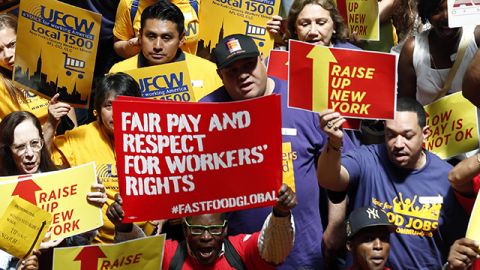
In this week’s show, activist and author Saru Jayaraman marches on Washington with restaurant workers struggling to make ends meet, and talks about how we can support their fight for better working conditions and a fair wage. She hopes viewers will speak out to help food service industry workers get the paychecks, health care and sick days they deserve, but often don’t receive.
“If consumers asked, every time they ate out, or said to the management, ‘Love the food, love the service, I would love to see you provide paid sick days, as a consumer that’s important to me,’ or ‘I would love to see you do better on your wages, not pay $2.13,’ just before leaving, we feel like that could make a tremendous difference in moving the industry,” says Jayaraman.
Jayaraman is co-founder and director of The Restaurant Opportunities Centers United, an organization that works to improve wages and working conditions for restaurant workers. For consumers, ROC publishes a guide to ethical eating, which lets you know which restaurants in your area treat their workers fairly. For restaurant workers, ROC provides job training, legal and organizing support. There’s also a free mobile version available for iPhone or Android. You can also visit thewelcometable.net to learn more. Restaurant owners and workers, also check out the Restaurant Worker Health Care Cooperative, which provides uninsured restaurant workers with timely, direct access to basic medical care at a low, reasonable cost.
Watch the full interview with Jayaraman on this weekend’s Moyers & Company. MORE
It sounds like the setup to a joke: How do you get a politician’s attention?
But it’s a question worth asking. The Internet has made it easier for constituents to send messages to the politicians who represent them — messages to Congress quadrupled between 1995 and 2004 — but it’s less certain that anyone is actually reading those messages.
Between 2007 and 2010, University of Bologna and NYU-Florence political scientist Christian Vaccari sent emails to 142 political parties and presidential candidates in seven western democracies, including the U.S., to gauge how each responded. He sent two emails to each party and candidate: One asked for the party or candidate’s position on taxes, the other asked for information about how to get involved as a volunteer.
At a conference on digital-era campaigning in London last month, Vaccari reported that only one in five of his emails received a reply within one business day; the majority of the emails, almost two-thirds, went unanswered. Vaccari found that, in general, parties tended to respond more often than individual candidates, and progressive parties tended to respond more often than conservative parties. MORE
In the aftermath of the tragedy in Newtown, CT, the nation’s attention has keyed in on details of that horrible event: the victims, including their names, ages, and accounts of the lives they led; the suspect, including speculation about his motivation and mental instability; and of course, the weapons — a Glock 10mm handgun, Sig Sauer 9mm handgun, and a .223 caliber Bushmaster AR 15 rifle. The last of the three, an assault weapon by federal definition, has inspired some to look past the object, past its North Carolina-based manufacturer, Bushmaster, to Bushmaster’s owner, Freedom Group; then a step further to the Park Avenue-based Cerberus Capital Management, the private equity firm that created and is a majority stakeholder in Freedom Group.
On Monday, a spokesman for the California State Teachers’ Retirement System – which has $750 million invested with Cerberus – told Reuters:
“At this point our investment branch is examining the Cerberus investment to determine how best to move forward given the tragic events of last Friday in Newtown, Connecticut…”
Hours later, Cerberus released a statement of their plan to “immediately engage in a formal process to sell” their interest in Freedom Group, saying:
“As a firm, we are investors, not statesmen or policy makers. Our role is to make investments on behalf of our clients who are comprised of the pension plans of firemen, teachers, policemen and other municipal workers and unions, endowments, and other institutions and individuals. It is not our role to take positions, or attempt to shape or influence the gun control policy debate. That is the job of our federal and state legislators.”
A dedicated group of concerned citizens do not believe that Cerberus’ decision to sell their majority stake in Freedom Group absolves them of responsibility. On Wednesday, they met outside the Upper East Side townhouse of billionaire Stephen Feinberg, the 52-year-old owner and CEO of Cerberus Capital Management. There they held a vigil and expressed their desire not only for federal and state action to address the deadly use of firearms, but also corporate accountability and dialogue from those responsible for their existence.
Jessica Wang, producer/editor; Cameron Hickey, camera
We’re proud to collaborate withThe Nationin sharing insightful journalism related to income inequality in America. The Nation contributor Greg Kaufmann writes a weekly roundup on the topic, “This Week in Poverty.” Share your thoughts about these must-read stories and always feel free to suggest your own in the comments section.
In a recent column, Bill Moyers and Michael Winship wrote, “When it comes to our ‘out of sight, out of mind’ population of the poor, you have to think we can help reduce their number, ease the suffering, and speak out, with whatever means at hand, on their behalf and against those who would prefer they remain invisible. Speak out: that means you and me, and yes, Mr. President, you, too.”
In the past year, it’s hard to imagine how anyone could have done more on the national stage to seek out and speak out on behalf of people living in poverty than broadcaster Tavis Smiley and Dr. Cornel West, professor of Philosophy and Christian Practice at Union Theological Seminary. This week, September 12–15, they will go on the road for their second poverty tour in a year, which they have dubbed “Poverty Tour 2.0.”
The bus for radio co-hosts Tavis Smiley & Cornel West on the road to Hayward, WI to kick-off 'The Poverty Tour: A Call to Conscience" in 2011. (AP Photo/Earl Gibson III)
In August 2011, Smiley and West embarked on an eleven-state, eighteen-city “Poverty Tour: A Call to Conscience”; that was followed in October by a week-long series about the tour broadcasted on both the Public Broadcasting Service (PBS) and Public Radio International (PRI). In January 2012, they collaborated with Indiana University’s School of Public and Environmental Affairs on a study examining the impact of the recession on people living in or near-poverty; the next day, Smiley moderated a panel live on C-SPAN—“Remaking America: from Poverty to Prosperity”—which included Dr. West, author and Nation contributor Barbara Ehrenreich, filmmaker Michael Moore and others. In March, Smiley moderated a nationally broadcasted panel of women who talked about the impact of poverty on women and children in America. Finally, Smiley and West co-authored The Rich and The Rest of Us: A Poverty Manifesto. It was released in April and peaked at #7 on The New York Times Best Sellers List.
In ten states so far — some of them swing states — voter ID laws make it prohibitively difficult for some voters, particularly the elderly, poor and minorities, to get required photo identification. Besides requiring voter ID, other laws have decreased the number of early voting days, made it harder for nonprofit groups to register new voters, and repealed election day voter registration.
Rather than throw your hands up in desperation at the powerful political steamroller smashing our democracy, Bill encourages you to re-double your efforts to make a difference, as others have. He offers some real-life, real-people examples, and asks you to share your encounters with politically-motivated rules that make it harder to register or vote, as well as stories of your efforts to overcome them.
Leave your reporting in the comments below or at “The Fight to Vote” our special area spotlighting voter suppression across the country. And please share his request with friends and family.
In this week’s show, Bill points out that, in Europe, food products made from genetically modified seeds must be labeled, and some Americans would like the U.S. to follow their example. Vandana Shiva says:
“Freedom, democracy, and choice is taken away. It’s taken away from the farmer by not allowing them to have their seed. It’s taken away from the consumer by not letting them have labeling to say what they’re eating. If there was labeling of GM foods, no one would eat it.”
On Moyers & Company, no good question goes unexplored — and we invite your help in that quest. On our Facebook page as well as this one, please share your answers, thoughts, and ideas on the question: Do you think foods with GM ingredients should be labeled? And if they were, would you still buy them?
Supporters attending a labor rally hold signs supporting rights to unionize at United Steelworkers union headquarters in Pittsburgh, PA. (AP Photo/Keith Srakocic)
“The percentage of union members in the American workforce has declined in the last 60 years from 35 to 12 percent, and labor has faced a pounding series of setbacks of which the Supreme Court’s Knox decision is just the latest. And yet, with corporations continuing to put the squeeze on employees, with joblessness and inequality rampant, now would seem the perfect time for people to turn back to unions to fight for them against the monied interests. Why haven’t they?”
On Moyers & Company, no good question goes unexplored — and we invite your help in that quest. On our Facebook page as well as this one, please share your answers, thoughts, and ideas on the question: Are labor unions still relevant?