Q&A features interviews with writers, economists, social scientists, activists and other big thinkers with important perspectives on issues affecting our democracy.
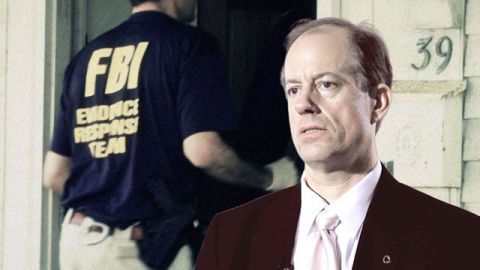
The Project on Government Oversight (POGO), a government accountability watchdog group, published a report this week on the so-called “revolving door” at the Securities and Exchange Commission. Authored by POGO Investigator Michael Smallberg, the report highlights numerous examples of how the back and forth of SEC regulators between jobs in Washington and on Wall Street blunts the agency’s effectiveness.
Smallberg includes recommendations for how the SEC and other parts of the government could take action to limit the negative effects of the revolving door. We spoke with Smallberg about his report and the corrosive effect of what he calls “regulatory capture” — what happens when an agency is “captured” by the industry it regulates.
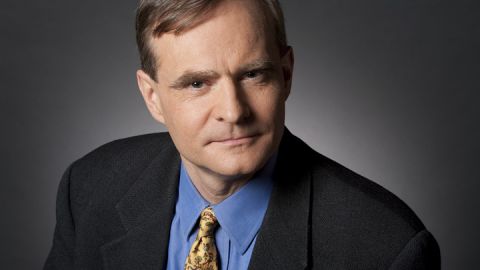
Michael Smallberg(Credit: Pam Rutter)
John Light: Why is the revolving door a potential problem for regulatory bodies in general, and specifically for the SEC?
Michael Smallberg: When you have so many people going back and forth from a regulatory agency to the regulated industry, it can shape the mindset of people throughout the agency and make them more sympathetic to the viewpoints of industry groups, sometimes at the expense of people with a stake in the agency’s mission, like consumers, investors or shareholders. In some cases, people who used to work at the agency have connections to people who are still there. They can take advantage of that access to obtain favors for their clients, who, in many cases tend to be large institutions that have the resources to hire these alumni.
The revolving door creates a risk of what we call “regulatory capture” — when companies are able to sway the policies of the agency in their favor. Many of these agencies are supposed to be independent regulatory agencies — independent not only from political pressure that might be applied by Congress, but also from large industry groups. The revolving door between a regulator and a regulated industry creates at least a heightened danger of regulatory capture.
Then there’s a question of optics: The appearance that a regulatory agency is cozying up to the companies it’s supposed to regulate can undermine the public’s confidence in the regulatory system, which in turn can make the regulatory agencies less effective. And on another level, the revolving door can devalue the notion of public service. When you have so many people who are looking at their government position as a stepping stone to going into the private sector and making much larger salaries working for the big companies, we worry that will demoralize other civil servants who are looking at their government service as more of a life calling.
In this image taken from video and released by SITE Intelligence Group on Monday, Nov. 8, 2010, Anwar al-Awlaki speaks in a video message posted on radical websites. Al-Awlaki is one of three U.S. citizens known to have been killed by American drone strikes.
A Justice Department white paper leaked to NBC News and reported on Monday sets out what administration attorneys believe is the legal case for drone strikes targeting American citizens — arguments that until now have not been fully revealed to the public.
In a New York Times op-ed piece last month, Vicki Divoll, a former general counsel for the Senate Select Committee on Intelligence and a recent guest on Moyers & Company, demanded that President Obama release documents detailing his legal argument for targeting and killing American citizens. We checked in with Divoll for some analysis of the newly leaked Justice memo.
Lauren Feeney: What are your initial thoughts after reading through the 16-page document?
Vicki Divoll: It’s going to take some time to sort through it. We need to step back and read the Supreme Court decisions referred to in the memo more carefully. But the thing that I found new and interesting is the discussion of the constitutional questions — the Fifth and Fourth Amendment questions.
Vicki Divoll
Their Fifth Amendment due process argument relies heavily on a 2004 Supreme Court case known as Hamdi v. Rumsfeld. Mr. Hamdi was a United States citizen picked up on the battlefield in Afghanistan who ended up in a military prison in Virginia. He filed a habeas petition that made it all the way to the Supreme Court arguing that he was entitled to some due process rights. The government argued that Hamdi did not have rights in this situation, as a detained enemy combatant, but the Court disagreed and concluded that he did have some level of due process rights. He was detained by his government and he had the right to be heard before an impartial factfinder. Shortly after the decision Mr. Hamdi was released. So the administration is now making the same argument again against due process rights for the individual, and relying on a 2004 case in which the court ruled against them the last time around. MORE
An unmanned U.S. Predator drone flies over Kandahar Air Field, southern Afghanistan, on a moon-lit night, Jan. 31, 2010. (AP Photo/Kirsty Wigglesworth, File)
In his 2009 Nobel Peace Prize speech, President Obama defended the right to engage in “just wars,” evoking a theory of ethical warfare that can be traced back to Saint Augustine, Thomas Aquinas, and even Cicero. Is the administration’s use of unmanned drone strikes compatible with the traditional principles of just war? We asked Daniel Brunstetter, a professor of political science at the University of California, Irvine, who has written about drones and just war theory for The Atlantic and the journal Ethics & International Affairs.
Lauren Feeney: What is “just war theory?”
Daniel Brunstetter
Daniel Brunstetter: Just war theory is a shared moral language that helps us facilitate our evaluation of the way in which statesmen can use force. I’ve heard it said that President Obama has been an avid reader of Augustine or Aquinas and that gives him the necessary knowledge of what just war theory is. One of the misconceptions about just war theory is that there is some book or checklist that you can turn to and say, “Do I satisfy this, do I satisfy that? Okay, great, I can go and wage war.” It’s more of a tradition in which there has been a long conversation dating from the times of Augustine, and it gives us a moral vocabulary that both structures and informs how we think about war and how we legitimize or don’t legitimize the use of force. MORE
Annie Leonard spent 20 years working for environmental organizations, studying where our stuff comes from and where it goes. She followed waste from industrialized countries to apartheid-era South Africa, where it was dumped in black townships, to Haiti, where it was disguised as fertilizer and dumped on a beach, to Pakistan, Indonesia and the Philippines where we sent everything from e-waste to used car batteries for recycling in a process too dirty for our own backyard.
Then, in 2007, she made a short animated film about our consumer culture and the damage it does to the environment. The Story of Stuff went viral (chances are you’ve seen it — more than 15 million people have) and spawned a whole series of videos that explain complicated environmental and political concepts in an irresistibly simple and engaging way. We reached Annie via email to talk about the latest installment, The Story of Change. This one’s a bit of a departure — instead of looking at the problem, it proposes a solution.
Lauren Feeney: I’ve often heard that one of the reasons we as a society have been so slow to act on climate change is that it’s kind of a boring subject, so it doesn’t get nearly the press coverage it deserves. How do we make it interesting?
Annie Leonard: We can communicate about climate change in a way that is abstract, technical and alienating – maybe even boring. Or we can communicate with stories, images and examples that are relevant and accessible to our daily reality. Melting ice caps and polar bears might not evoke immediate concern from today’s urban communities, but increasing food prices, health impacts and extreme weather do. Environmental researchers and scientists tend to lead with the data, which is understandable considering how terrifying and compelling the climate data is. It’s hard not to want to share it with everyone we pass on the street. But we’re learning that data alone doesn’t inspire people to act at the level needed. Heck, data alone doesn’t even inspire people to do simple things, like improve our diets or exercise more. When we’re communicating about climate change, it serves us to keep the data and technical jargon on tap, not on top. We need to understand the science for ourselves and for those who want to know more, but not lead with it. Lead with our hearts, our humanity, our empathy, our stories and we’ll see greater results. MORE
As the year draws to a close, we checked in with linguist Geoffrey Nunberg to get his analysis of the top political buzzwords of 2012.
Lauren Feeney: What political words struck you as particularly interesting this year?
Geoffrey Nunberg: Like all campaigns, this one generated a bunch of nine-day wonders — words of the week or month like “Romnesia,” “Etch-a-Sketch,” “self-deportation,” “unskew,” and so forth. Others were more insistent — “dark money,” “SuperPAC.” When I was trying to pick a word of the year for my Fresh Air language feature, I was tempted by Romney’s “47 percent.” I think it stands for a shift in the language of class in American politics, as a kind of bookend to last year’s “one percent.” The right used to insist that there were no classes in America — even to mention the word was class warfare. Now they’ve drawn up their own battle lines in the middle.
But it’s a little misleading to focus on that one item — words really fly in flocks, and this one comes with “moochers,” “takers,” and “lucky duckies,” the repellent term coined by The Wall Street Journal about a decade ago, not to mention “gifts” and “goodies.” And in particular there’s “entitlement”— not a recent word, of course, but it figured a lot in the election, particularly after Ryan’s nomination, and it has been shifting its meaning in what I’ve described as a kind of semantic sleight-of-hand. Time was that “entitlement” was a positive word which implied that people had a moral right to certain government benefits. Bill Moyers recalls what LBJ said to the Republicans about Medicare: “By God, you can’t treat Grandma this way. She’s entitled to it.” Then the word got colored by the psychological meaning it has in “sense of entitlement,” where it implies an unwarranted claim to something. When people on the right talk about the “entitlement society” nowadays, there’s an unspoken “unearned” in the background; it evokes the “culture of dependency” narrative — “entitlement” has become just another word in that “47 percent” and “moocher” lexicon.
When former FCC Commissioner Michael Copps stopped by our offices a couple of weeks ago to talk about possible FCC plans to further relax media ownership rules in major media markets, we got to talking about the broadcast media’s responsibility to the American public. The people own the airways, after all, and we wondered whether there had ever been a “golden age” at the FCC when the public’s interests were truly championed.
Copps mentioned the Blue Book, a set of guidelines the FCC released – and later disavowed – during the 1940s, when the commission experienced a short-lived period of progressive activism. Victor Pickard, an assistant professor at the University of Pennsylvania’s Annenberg School for Communication, has researched and written about the battle over the Blue Book, when broadcasters used red-baiting scare tactics to prejudice the public against the report’s proposed guidelines.
Theresa Riley: Most people have never heard of the Blue Book. What was it and why should we care about it today?
Victor Pickard
Victor Pickard: The Blue Book (so named because of its blue cover) was a controversial report published by the FCC in 1946. Officially titled the “Public Service Responsibility of Broadcast Licensees,” it defined substantive programming guidelines for judging radio broadcasters’ performance at renewal time and was the FCC’s first significant effort to clarify its public interest standard.
This history is significant because, despite narratives to the contrary, the term “public interest” hasn’t been left undefined by a lack of effort or because it’s inherently indefinable; it has remained ambiguous because media industries, particularly commercial broadcasters, have fought aggressively to keep standards — and methods to enforce them — vague and ineffectual.
Childhood obesity has long been considered one of the nation’s most intractable problems, complicated by issues like race, poverty and a culture that to many seems more concerned with corporate profits than children’s health. About 17 percent of American children are obese; among low-income children, the rate rises to 20 percent. But a recent report shows that the tide may finally be turning, with childhood obesity rates declining by 3 -5 percentage points in cities like New York, Los Angeles and Philadelphia.
The reasons for the reversal are still unclear, but it would be hard for anyone familiar with the work of Philadelphia’s Food Trust to discount the impact of that organization and others like it. We called Food Trust Executive Director Yael Lehmann to learn more about the new report and the role of activists in reversing the trend.
Lauren Feeney: Several U.S. cities saw childhood obesity rates drop for the first time in decades, with your city, Philadelphia, seeing some of the most dramatic improvement. To what do you attribute this turn-around?
Yael Lehmann: This is an extraordinary moment where we’re finally seeing these glimmers of hope. It’s hard to know what to attribute it to, but I believe it’s this comprehensive approach, combining education with access to healthy foods; policy makers and people in the trenches.
Feeney: Philadelphia, the poorest of America’s ten largest cities, saw the greatest decline in obesity among minority children. Why do you think that is?
Lehmann: In most cities, the improvement was mostly among white kids, but among minority kids you just weren’t seeing it. Philly is the only city that didn’t have those same racial disparities. We saw a seven percent decline for African-American boys and an eight percent decline for Hispanic girls.
It takes an army, you know. It takes everyone from the mayor on down. We work in every part of the city; there’s no stone left unturned. We work in the lowest income areas, the most distressed neighborhoods, in every school. I think that’s at least part of the reason why we didn’t have the same racial disparities in our results. MORE
Former FCC Commissioner Michael Copps discusses the upcoming FCC vote to relax media consolidation laws with Bill Moyers. (photo credit: Dale Robbins)
This week, we’re focusing on the Federal Communications Commission’s proposal to relax the rules that prevent one company from owning radio stations, television stations and newspapers all in the same city — a move activists say would hurt diversity and be a boon for the Rupert Murdochs of the world.
It’s déjà vu for Michael Copps, who served on the commission from 2001-2011 and was acting chairman from January to June 2009 — a tenure marked by his concern for diversity and opposition to media consolidation. Copps is now the senior advisor for media and democracy reform at Common Cause. He stopped by our office Monday to share his concerns about the FCC’s latest proposal.
Bill Moyers: After all the conversations we’ve had over the years, why are we still talking about media concentration today?
Former FCC Commissioner Michael Copps. (Photo credit: Robin Holland)
Michael Copps: Because media concentration is still very much a reality today. If you opened up the papers last week, you’ll see Rupert Murdoch is maybe thinking about buying the Los Angeles Times or the Chicago Tribune. Every time you have one of these consolidation transactions, they look around for all of these wonderful economies and efficiencies that they’re supposed to harvest from becoming big conglomerates. The first thing they think is, “How do we impress Wall Street now? Where do we cut?” And the first place they cut is the newsroom. We’ve had, across this country, hundreds of newsrooms shuttered, thousands of reporters who are walking the streets in search of a job, rather than walking the beats in search of stories. And the consequence of that is, I think, a dramatically dumbed down civic dialogue that is probably — and I don’t think I’m exaggerating — insufficient to sustain self-government as we would like to have it.
There’s this wonderful story about Bill Paley, who I never knew, but —
The Federal Communications Commission is set to vote to relax a longstanding ban that prevents one company from owning radio and television stations and newspapers in the same city — a move that activists are calling a giant Christmas present to Rupert Murdoch. The media titan has floated the idea of buying The Chicago Tribune and The Los Angeles Times, the dominant papers in cities where he already owns TV stations. What’s worse, the FCC is operating behind closed doors, rather than inviting public comment on the issue.
Craig Aaron, Free Press
So Craig Aaron, president and CEO of Free Press, is asking people to speak out — by signing a petition, writing an editorial and calling congressmen. Aaron and his organization have been among those leading the charge against increased media monopolization. Similar attempts to change ownership rules were thwarted in 2003 and 2007. Earlier today, Bill Moyers caught up with Aaron via Skype to learn more about the current proposal and what viewers can do to help stop it.
Bill Moyers: Craig Aaron, tell us what you know about this FCC ruling that’s under consideration?
Craig Aaron: Well, what I know is that, according to all trade reports, the Federal Communications Commission is considering moving very quickly to get rid of longstanding limits on how much media one company can own in a town. And if they go with the plan that they’re currently considering, it would open the door to one company owning the daily newspaper, two television stations, eight radio stations, possibly even your internet service provider — all in one community. These are the exact same rules that are preventing someone like Rupert Murdoch of Fox News from owning The Chicago Tribune or owning The Los Angeles Times. If these rules go away, suddenly deals like that become possible.
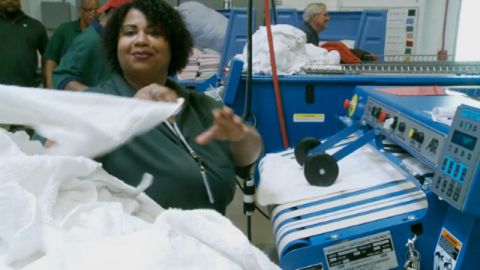
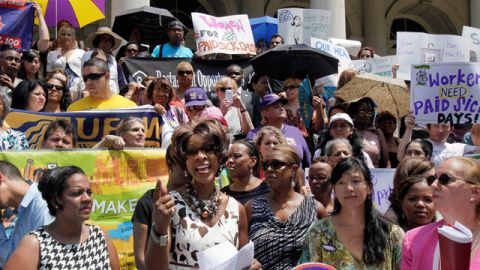
Domestic workers — the nannies, housekeepers, and home health aides who care for our young children and elderly parents — have traditionally been excluded from the most basic protections, like minimum wage. Their jobs are inherently insecure, ending abruptly when the child goes off to school or the patient passes on, yet few collect Social Security or are eligible for unemployment benefits. Working behind closed doors in private homes, they are vulnerable to abuse and unable to organize.
Enter Ai-jen Poo. The community organizer has been advocating for domestic workers’ rights for over a decade, and in 2010, led the campaign for the nation’s first Domestic Workers Bill of Rights, which theoretically guarantees overtime pay, paid vacation, and basic human and civil rights protections for over 200,000 workers in the state of New York. Now she’s working to bring the same rights to domestic workers nationwide.
This week, Poo’s organization, the National Domestic Workers Alliance, together with the University of Illinois at Chicago and the DataCenter, released the first-ever national survey of domestic workers, Home Economics: The Invisible and Unregulated World of Domestic Work. Poo sees it as a call-to-action for the nation to tackle the problems of this unregulated sphere, problems that in a Venn diagram would overlap with race, immigration, gender, and the modern, middle-class dual-income family.
Lauren Feeney: What are some of the most important findings in your report?
Ai-jen Poo: The fact that the report exists at all is important because for so long there hasn’t been any real data on domestic work, and that’s contributed to the invisibility of these workers and the Wild West nature of this industry. Now we have data from surveys of 2,086 domestic workers in 14 different cities from 71 different countries of origin.
What we found is that the people, mostly women, who we count on to take care of the most precious elements of our lives — our homes and our families — do not earn enough to take care of their own families or themselves. Twenty-three percent of domestic workers earn below minimum wage. That’s not counting live-in domestic workers. Among live-ins, sixty-one percent earn below minimum wage. And I think all of us know that even minimum wage is impossible to survive on.
Feeney: How is it that in 21st century America — after all the successes of the labor movement, the women’s movement, the civil rights movement — there is still this segment of the population that lacks even the most basic protections under the law? Why were these people left behind?
Poo: One reason is the legacy of racism in this country. In the 1930s, Southern members of Congress refused to support the labor laws within the New Deal if farm workers and domestic workers, who were largely African-American at the time, were included under those protections — protections like the Fair Labor Standards Act and the National Labor Relations Act.
The people who have done this work have historically been poor, working poor women — immigrant women, African-American women, white poor and working class women — socially disadvantaged people. Then there’s the fact that this work has been seen as women’s work and has never really been valued or recognized as real work — it’s a battle to even get recognition as work and as workers versus just help or companionship.
All of those factors connected have meant that this work is done in the shadows. Now, with the need for this work just growing exponentially and becoming so much a part of the lifeblood of this country and the economy, we have an opportunity to really turn the tide on that.
Feeney: What makes domestic work so important to the economy?
Poo: The economist Jared Bernstein calls it a “critical input.” We call it the work that makes all other work possible. It’s this invisible layer of work — raising families and taking care of homes — that allows other people to go into their public lives and work, achieve, build.
Feeney: You call for a living wage, paid sick days, paid vacation and health insurance for domestic workers, and I don’t think anyone would argue that these women don’t deserve these basic protections. And of course, it’s easy to point a finger at wealthy executives and politicians who don’t treat their nannies well. But what about middle-class working women with limited options for child and elder care who really can’t afford any more than they’re already paying?
Poo: We need to take a holistic approach that’s not just about workers’ rights but about a whole set of policies that will make it more possible for all of us to take care of the people that we love. So we also promote tax credits and paid family leave policies and all kinds of workplace flexibility policies for working parents.
We’re living in a 21st century economy where the majority of paid workers are women, yet they’re still responsible for the vast majority of caregiving responsibilities. Our society, in the rules and structures that currently exist, has not accounted for that whole arena of work. And the manifestation of that is the low wages and invisibility and abuse of domestic workers. But really every single family is impacted by the fact that we haven’t adequately accounted for the work that goes into caring for families. Families need help, they need childcare, they need eldercare, and they don’t always have the resources to afford it. Why don’t we have universal childcare? Why don’t we have workplace flexibility policies that account for the fact that people get sick and family members have to take care of them? It just seems very basic and it can absolutely be done. We really need to rethink the whole way we account for work and structure the economy in a way that works for everyone.
Feeney: In the meantime, what would you suggest concerned employers do to make sure that they’re treating their caregivers fairly, and what can domestic workers and their allies do to get involved in your campaign?
Poo: If you’re an employer, I would really encourage you to go to the Hand-in-Hand Domestic Employers Association website and sign up for their list. And for domestic workers, I would say join one of our affiliate organizations or the national alliance. We’re doing work in twenty-four cities in fourteen states and the District of Columbia, so we have affiliates all over the place, and if people want to form an organization in their town, we’ll support it. We’ve got big campaigns moving forward in California, Massachusetts and Illinois in 2013, so people can get involved in changing the policies and laws that will affect their lives in the future. That’s a call for employers too — we need employers to support our standards and guidelines, and their voices will be really important in that cause. Finally, there’s a measure that’s waiting in the wings at the Department of Labor that would bring 1.8 million home care workers under federal minimum wage and overtime protection, and we need people to write letters to their local Congress members and to the president himself saying that they want to see homecare workers included under basic protections. We’ve got to take care of our caregivers.