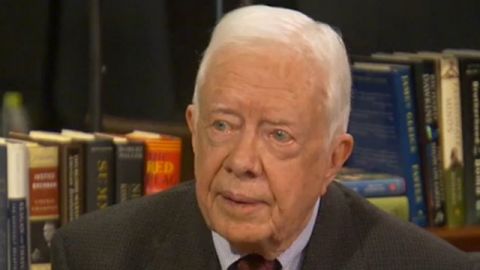

Paul Krugman and John Maynard Keynes (AP Photo/Fredrik Persson, Scanpix Sweden)
Paul Krugman has been called “today’s leading interpreter of John Maynard Keynes,” the British economist whose ideas created a shift in thinking about macroeconomics during the 1930s, when the U.S. was struggling to recover from the Great Depression. Keynesians tend to favor public sector spending — a tactic that suceeded when Franklin D. Roosevelt’s administration prepared for war in Europe — to help economies through difficult times.
In fact, Krugman — who was recently interviewed on Moyers & Company — even introduced Macmillan’s recent edition of Keynes’ seminal work, The General Theory of Employment, Interest and Money calling it “the most important book in the history of economics.” MORE
The tradition of asking a poet to compose and recite a poem for the inauguration began in 1961 with John F. Kennedy, who asked Robert Frost. The idea has been revived twice — first by Bill Clinton, who invited Maya Angelou and then Miller Williams to speak at his first and second inaugurations, and again by Barack Obama, who invited Elizabeth Alexander to speak in January 2009, and now, Richard Blanco.
Blanco often writes in author statements that he was “made in Cuba, assembled in Spain, and imported to the United States” — meaning that he was conceived in Cuba by Cubans, who fled Fidel Castro and lived in Spain as exiles for 45 days, where Blanco was born, before continuing on to America. He was named for Richard Nixon, who took a strong stand against Castro (and who, TIME magazine points out, was born exactly 100 years before the day that Obama’s selection of Blanco was announced). Blanco will be both the first Latino and the first gay poet to read at a presidential inauguration. At 44, he’s also the youngest.
Addie Whisenant, the inaugural committee’s spokeswoman, told The New York Times that Mr. Obama picked Blanco because his “deeply personal poems are rooted in the idea of what it means to be an American.” In this YouTube video, Blanco reads his poem Betting on America:
Economist and New York Times columnist Paul Krugman is in the studio today with Bill to tape this weekend’s episode of Moyers & Company. Krugman explains how our current obsession with slashing the deficit is getting in the way of real work that needs to be done to preserve both our economy and our democracy. You can find out when to watch by using our TV schedule tool.
In preparation for Krugman’s visit, we’ve been listening to “The Krugman Blues” by folk musician Loudon Wainwright III. The song was on Wainwright’s January 2010 album, 10 Songs for the New Depression.
In this video, Wainwright performs “The Krugman Blues” — explaining why he finds Krugman’s worldview and dour mannerism so appealing — at The New Yorker.
We’re proud to collaborate withThe Nationin sharing insightful journalism related to income inequality in America. The following is an excerpt from Nation contributor Greg Kaufmann’s “This Week in Poverty” column.
Throughout these budget talks, the Obama Administration has projected an image that it is open to good ideas from anyone, and interested in the prosperity of everyone.
JP Morgan Chase & Co. Chief Executive Officer Jamie Dimon, left, and Goldman Sachs Chief Executive Officer Lloyd Blankfein leave the White House in Washington in 2009 following a meeting between chief executives and President Barack Obama. (AP Photo/Evan Vucci)
But there is an omission from the president’s rounds — one that is all the more glaring since this group of people is arguably more vulnerable than anyone to any final budget decisions: low-income Americans who are struggling to climb up from the lower rungs of the economic ladder.
When is their White House meeting? Where is their place at the table?
Surely, this Administration wants to send a message that this White House is open to all Americans. More importantly, it no doubt recognizes that lower-income Americans are working just as hard at their jobs, trying just as hard to create opportunities for their children and wanting just as much to improve their communities, as are Americans who have more resources. MORE
We were pretty sure this would happen. But 2012 is now officially the warmest calendar year on record for the contiguous U.S., according to the National Oceanic and Atmospheric Administration. It was also the second most severe year for natural disasters — 1998 is the first — with 11 extreme weather events causing over $1 billion in damage. MORE
Next week, Bill will be talking with Paul Krugman, the Nobel laureate in economics and New York Times columnist about the fiscal cliff, the debt ceiling and his new book, End This Depression Now! For this conversation, Bill invites your help. On our Facebook page as well as in the comments below, please share your questions for Krugman. Some of them may make their way into Bill’s interview, and even if they don’t, you still always have a virtual seat at his table.
Use our TV Schedule tool to find Moyers & Company air times and channels where you live.
1/10/2013 UPDATE:We are no longer accepting questions for Paul Krugman, because the interview happened earlier today, but you can watch a preview in which Krugman discusses Jack Lew, President Obama’s Treasury pick, and why he’s okay with not being chosen. Thanks for your questions!
We’re proud to collaborate withThe Nationin sharing insightful journalism related to income inequality in America. The following post originally appeared in The Nation.
If you had told me in recent months that on January 2, 2013, we would have unemployment insurance extended for a year, an improved child tax credit and earned income tax credit extended for five years and no cuts to food stamps (SNAP), Medicaid or Social Security — I would have told you that you were out of your mind.
Speaker of the House John Boehner returns to his office from the House chamber on Jan. 1, 2013. (AP Photo/Jacquelyn Martin)
I understand that the criticism coming from the left about this deal is based largely on where things stand for the next round of negotiations, and also a concern that the deal didn’t raise sufficient revenues to avert substantial cuts down the road. But I’m troubled by the lack of attention being paid to how this deal benefits the more than one in three Americans living below twice the poverty line — earning less than $36,000 annually for a family of three, and the 46 million Americans living below the poverty line (less than $18,000 annually for a family of three).
I’m reminded today of a politically active homeless woman I spoke with earlier this year, who — although she is disgusted with Republican policies — was even more frustrated with “so-called progressives” (her words) whom she said talk about caring about poor people but fail to sufficiently speak up about their issues, bring them into their advocacy work and address their concerns in an ongoing and substantive way.
We’re proud to collaborate withThe Nationin sharing insightful journalism related to income inequality in America. The following is an excerpt from Nation contributor Greg Kaufmann’s “This Week in Poverty” column.
In my work covering poverty this past year, I’d be hard pressed to come up with anyone who is doing more to shatter the myths about single mothers in the U.S. than Tim Casey, senior staff attorney at Legal Momentum, the nation’s oldest organization advocating on behalf of the legal rights of women and girls.
Casey himself was raised by a single mother, and he is relentless in his pursuit of the facts about the real lives and living conditions of single parent families in America — especially critical at a moment when women are demonized for being unmarried and blamed for their circumstances.
In this May 2005 picture, Toni Gates, a 24-year-old single mother, sits in the living room of her home in Milwaukee. She works part time as a nursing assistant and earns about $500 every two weeks. "It is sort of hard to make ends meet," she said. "You've got the kids, you try to make it home and make dinner and get everything done for the next day." (AP Photo/Morry Gash)
Last week, Casey and his colleague, Laurie Maldonado, research associate of the Luxembourg Income Study Center at the Graduate Center City University of New York, released an exhaustive new report, Worst Off — Single-Parent Families in the United States, A Cross-National Comparison of Single Parenthood in the U.S. and Sixteen Other High-Income Countries.
We’re proud to collaborate withThe Nationin sharing insightful journalism related to income inequality in America. The following is an excerpt from Nation contributor Greg Kaufmann’s “This Week in Poverty” column.
A Broader, Bolder Christmas: Top Ten “Gifts” for Under the (Education Policy) Tree
10. A roof over every student’s head Children who lack stable homes are more anxious and less focused than their peers who have adequate housing. They are also at higher risk for poor health and developmental problems and have lower educational attainment. There is no reason why any child in the United States should not enjoy stable housing. Moreover, we end up paying more for children to sleep in cars or in shelters than we would to provide their families with apartments. It’s time to fund the National Housing Trust Fund that was signed into law by President George W. Bush but never funded.
Courtney Thornton, left, 10, and her mother, Colleen Thornton, participate in a candlelight vigil in January outside the Chester-Upland School District administration building in Chester, Pa. Nearly two decades after being declared financially distressed, the long-struggling Chester Upland School District was on the verge of running out of cash. (AP Photo/Matt Slocum)
We’re proud to collaborate withThe Nationin sharing insightful journalism related to income inequality in America. The following is an excerpt from Nation contributor Greg Kaufmann’s “This Week in Poverty” column.
In a somewhat bizarre op-ed last week, New York Times columnist Nicholas Kristof acknowledged, “I’m no expert on domestic poverty,” and then seemingly set out to prove it.
Chrissy Fairbanks poses with her daughters Angela, 11, and Alexus, 12, at their home, in Keene, N.H. Chrissy Fairbanks has been legally blind since she was 9, and the Fairbanks family receives Supplemental Security Income for the disabled. (AP Photo/Jim Cole)
He drew a dangerous and brazen, anecdotally based conclusion that the Supplemental Security Income (SSI) program, which benefits one of the most vulnerable populations in the country — low-income children with disabilities and their parents — must be cut and those resources diverted to early education initiatives in order to help children escape poverty. The thrust of Kristof’s argument is based on a secondhand account of parents in Appalachian Kentucky who allegedly pulled their children out of a literacy program in order to continue receiving disability benefits.